Complete Runtime & Lifespan Guide for Lithium and Deep Cycle Batteries – By HHS Energy
One of the most common questions buyers ask is:
How long will a 12V 100Ah battery last?
The answer depends on two key factors:
How long it powers your devices (runtime per charge)
How many years it lasts before replacement (overall lifespan)
In this guide, we’ll break down both aspects clearly, using real-world examples to help you calculate runtime and understand long-term durability—especially for modern LiFePO4 batteries.
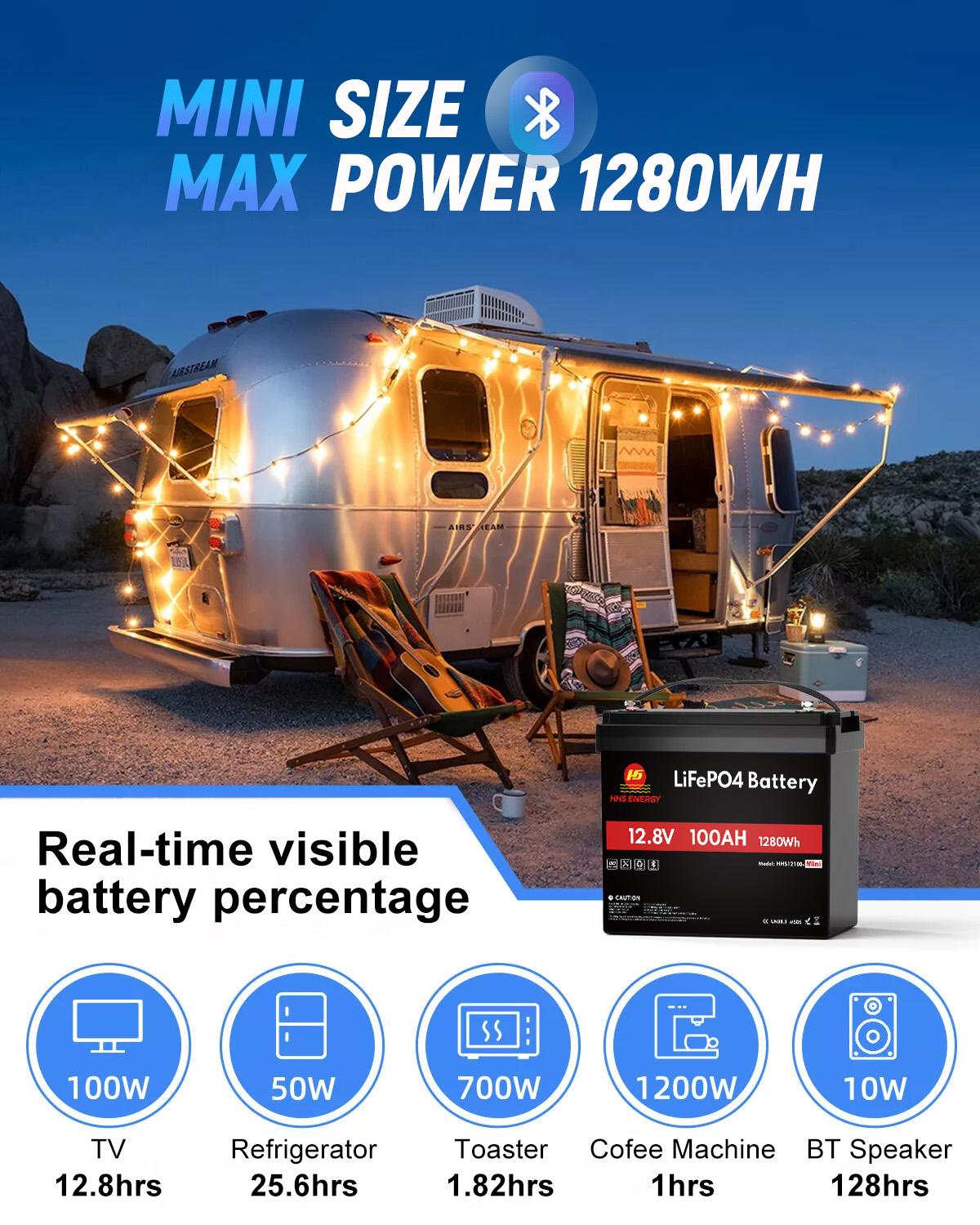
A 12V 100Ah battery provides:
12 volts × 100 amp-hours = 1,200 watt-hours (Wh)
For lithium batteries (nominal 12.8V), the usable energy is typically:
12.8V × 100Ah = 1,280Wh
This means the battery can theoretically supply:
100 amps for 1 hour
50 amps for 2 hours
10 amps for 10 hours
1 amp for 100 hours
However, real-world performance depends on load, efficiency, battery type, and environmental conditions.
To estimate runtime, use this simple formula:
Battery Watt-Hours ÷ Device Watts = Runtime (hours)
1,200Wh ÷ 100W = 12 hours
So a 12V 100Ah battery can power a 100W device for approximately 12 hours (ideal conditions).
1,200Wh ÷ 1,000W = 1.2 hours
In reality, inverter efficiency (around 90%) reduces runtime slightly:
Actual usable ≈ 1,080Wh
1,080Wh ÷ 1,000W ≈ 1 hour
Let’s say your RV uses:
Lights: 50W
Refrigerator: 100W (average cycling)
Water pump: 60W (intermittent)
Electronics: 100W
Total average load ≈ 250W
1,200Wh ÷ 250W ≈ 4.8 hours of continuous use
Since many devices cycle on/off, real-world daily usage often lasts significantly longer.
This depends entirely on battery chemistry.
300–500 cycles
3–5 years typical
Only 50% usable capacity recommended
Sensitive to deep discharge
If used daily, it may last 1–2 years.
A high-quality LiFePO4 battery offers:
3,000–5,000+ cycles
8–10 years typical lifespan
90–100% usable capacity
Stable voltage output
Low maintenance
If cycled once per day:
3,000 cycles ÷ 365 days ≈ 8+ years
Premium batteries from HHS Energy are engineered for long-term daily cycling, making them ideal for RV, marine, and solar applications.
Several key factors influence both runtime and lifespan:
LiFePO4 lasts significantly longer than:
Lead-acid
AGM
Gel batteries
Chemistry determines durability.
The deeper you discharge regularly, the shorter the lifespan (especially for lead-acid).
LiFePO4 batteries tolerate deep discharge much better.
Higher loads:
Drain faster
Generate more heat
Stress internal components
Proper battery sizing improves longevity.
Extreme heat shortens lifespan.
Extreme cold reduces available capacity temporarily.
Ideal operating range:
10°C–30°C (50°F–86°F)
Using incorrect chargers can:
Overcharge
Cause imbalance
Reduce lifespan
Always use lithium-compatible chargers for LiFePO4 batteries.
A 12V 100Ah LiFePO4 battery typically lasts:
1–2 days of moderate RV use
8+ years overall lifespan
For trolling motors:
4–8 hours depending on thrust level
5–10 years lifespan with proper care
In off-grid setups:
Provides daily cycling capability
8–10 years typical service life
To maximize longevity:
Avoid frequent full discharges (when possible)
Use proper charging voltage
Store at 40–60% charge if unused
Avoid extreme heat exposure
Choose high-quality battery brands
At HHS Energy, strict quality control, premium Grade A cells, and advanced BMS protection ensure long-lasting performance in demanding environments.
| Load | Approximate Runtime |
|---|---|
| 50W | 24 hours |
| 100W | 12 hours |
| 200W | 6 hours |
| 500W | 2.4 hours |
| 1000W | ~1 hour |
(Actual runtime varies by efficiency and battery type.)
A 12V 100Ah battery typically lasts:
1–24 hours depending on load
Lead-acid: 3–5 years
LiFePO4: 8–10 years
For users seeking long-term reliability, lightweight design, and superior cycle life, LiFePO4 is clearly the better choice.
When built with premium cells and intelligent protection systems, like those from HHS Energy, a 12V 100Ah LiFePO4 battery delivers dependable power for nearly a decade.